
Rods And Mains Gone Awry
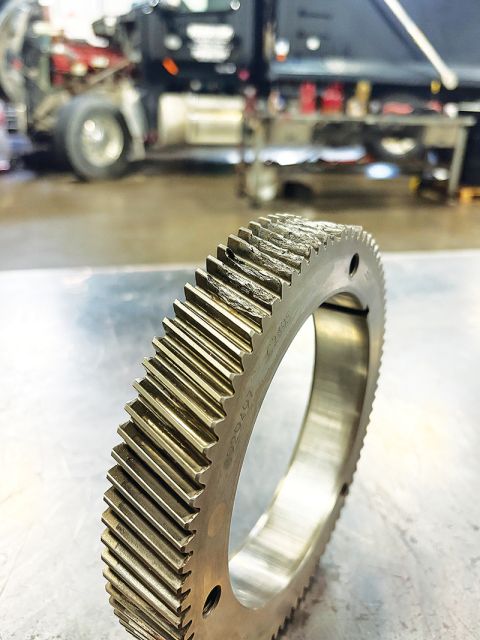
The job ticket called for rods and mains on a Detroit Series 60—typically a straightforward, same day repair. The customer arrived at Pittsburgh Power expecting a routine bearing refresh: new connecting rod and main bearings, torque to spec, and back on the road. Once we pulled the oil pan, the scope changed. What looked routine was not.
During teardown, the crank gear was found to have a large section of teeth missing. The bull gear was also damaged, and metal debris was present in the pan.
In an ideal world, extensive damage to both gears would point to a three quarter block replacement or a full gear train overhaul, since adjacent components may also be compromised. Given schedule and budget constraints, we discussed risk, cost, and downtime with the owner and agreed on a targeted plan: thoroughly clean the engine, replace the bull gear and crank gear, and proceed with the rods and mains as planned.
Can you change the crank gear without pulling the crank? On a Series 60, yes. The crankshaft timing gear is press fit; with the correct puller and installer, it can be removed and installed accurately. This is a controlled, hydraulic, tool driven process. The gear mounts at the front of the crank, drives the bull gear, and engages the oil pump drive gear—details that matter when diagnosing the failure.
With the plan set, we disassembled to the level required for gear work. We flushed the internals with mineral spirits repeatedly until clean. After a gear failure, reassembly requires a contamination free environment; any remaining debris can damage journals, bearings, or pumps. We pressed on the new crank gear to specification, installed the new bull gear, torqued the rods and mains, verified clearances, and inspected all related components.
The truck arrived for a bearing refresh and left with a renewed front gear train. The owner received a solution that respected their constraints, and the engine is back in service. That leaves an important question: how can a crank gear and bull gear fail while the oil pump remained unaffected?
One plausible explanation is localized tooth overload between the crank gear and bull gear that did not involve the sector where the crank gear meshes with the oil pump drive gear. The Series 60’s crank gear engages the bull gear over one sector and the oil pump gear over another. If the initiating event occurred in the bullgear sector, you can destroy teeth there while the oil pump mesh remains intact. Gear failures can be highly localized.
Another possibility is torsional vibration from a worn or failed crankshaft damper. Without proper damping, oscillations fatigue the tooth roots with cyclic loads until material is lost. The bull gear typically sees higher and more variable torque because it drives multiple accessories, so it tends to fail first. The oil pump sees a steadier load with lower inertia changes, making it less likely to be the initial failure point.
A brief accessory seizure could also transmit a shock through the bull gear. Because it distributes torque to the fuel pump drive, air compressor, water pump, and other accessories, a momentary bind can shear one or two adjacent teeth without affecting the oilpump mesh.
Prior repair history matters as well. Pressfit gears require proper heating, alignment, and seating depth. A crank gear installed with slight runout can gradually degrade the mesh. The failure appears sudden even though the process began long before. In such cases, the bullgear mesh, which carries more variable load, often shows damage first. The oil pump, with steadier loading, may not exhibit the same symptoms.
In summary, the oil pump likely survived due to geometry and duty cycle. The crank gear’s engagement arcs allow damage to be confined to the bullgear sector. If the failure occurred there, the oil pump mesh would not encounter the broken teeth. Operationally, the pump’s steadier load profile makes catastrophic tooth failure less likely. It is still vulnerable to issues like starvation or contamination, but in scenarios driven by shock loads, misalignment, or torsional vibration, it is less likely to be the primary failure.
Written by: Jordan Greathouse, Marketing Manager, Pittsburgh Power, 3600 South Noah Drive, Saxonburg, PA, 16056. Phone (724) 360-4080. Website: www.Pittsburghpower.com