
Founders & Guardians - Fred Rogers
© 2026, M. R. McGough, LLC
“We live in a world in which we need to share responsibility. It's easy to say ‘It's not my child, not my community, not my world, not my problem.’ Then there are those who see the need and respond. I consider those people my heroes.”
Fred Rogers
Fred McFeely Rogers, was born on Tuesday, March 20, 1928, in Latrobe, Pennsylvania. He was named for his maternal grandfather, Fred McFeely, with whom he had a close and impactful relationship. Young Fred began playing the piano at an early age, and he developed an interest in puppets, both of which would always be part of his life’s work. He attended Latrobe High School where he overcame some childhood shyness to become editor of the yearbook, president of the student council, and a member of the National Honor Society. He graduated in 1946.
After high school, Fred attended Dartmouth College for a year, then transferred to Rollins College, earning a degree in music in 1951. He later completed degree work in divinity from Pittsburgh Theological Seminary, and in 1963, he was ordained as a Presbyterian minister. In the mid-60’s, he attended the University of Pittsburgh graduate school of child development.
While at Rollins, Fred met Sara Joanne Byrd, also a music major. They married in 1952, and had two sons. In addition to working with Fred, Sara had a long career as a performing concert pianist. Following her husband’s passing, she devoted herself to perpetuating his memory and legacy.
Rogers began his television career with NBC in New York, in 1951. He went into television to address his sincere concerns regarding programming for children. After two years in New York, he returned to Pittsburgh to work at station WQED. By 1955, a new show, The Children’s Corner, became part of that station’s programming. For four years beginning in 1963, he worked with the Canadian Broadcasting Corporation to create the program Misterogers. He returned to Pittsburgh in 1967, where he created and then stared in a new children’s program for National Educational Television, which later became Public Broadcasting Service (PBS). That program was Mister Roger’s Neighborhood.
Through nearly 900 episodes over 33 years, Mister Rogers brought a fresh change to television for children. In Roger’s neighborhood, issues in the lives of children were covered in a calm and slow, yet purposeful and meaningful manner. He included such subjects as the birth of a baby, civility, individual self-worth, sharing, tolerance for others, the loss of a pet, divorce, human dignity, death, and dealing with personal feelings. Following the death of Senator Robert Kennedy in 1968, Rogers covered the very difficult topic of political assassination.
Rogers’ show was a new and welcome model. It’s theme song, “Won’t You Be My Neighbor,” became a classic. The last original episode ran in 2001, but PBS continued showing reruns through 2016. In addition to being one of the longest-running programs in PBS history, Mister Rogers’ Neighborhood remains today, a gold standard of children’s programming.
In addition to his television show, Rogers was an activist for children. In 1969, he testified before a US Senate subcommittee considering a $10 million cut to an appropriation bill to fund PBS. Due in no small measure to Rogers’ testimony, the full appropriation of $20 million was approved. The following year he was named chair of the White House Conference on Children and Youth.
The man who actor Tim Robbins referred to as, “The best neighbor any of us has ever had” at the 1997 Emmy Awards, died on February 27, 2003. The cause of death was stomach cancer, which had been diagnosed the previous year. He was 74 years old.
In addition to that 1997 Emmy Award for lifetime achievement, Rogers received more than 40 honorary degrees, distinguished alumni awards, and numerous media recognitions. In 1998, his star was added to the Hollywood Walk of Fame, and the next year he was inducted into the Television Hall of Fame. He was the first recipient of the Fred Rogers Award, presented in 2001, by the Corporation for Public Broadcasting. President George Bush presented him with the Presidential Medal of Freedom in 2002. In 2018, he appeared on a commemorative US Postage stamp, and in 2021, he was posthumously received a Grammy Award. In 2026, the Pittsburgh Penguins hockey team announced the first-ever Mister Rogers’ Neighborhood Day, to “. . . celebrate the series’ legacy of kindness, compassion and modeling what it means to be a caring neighbor – values that continue to resonate across generations in Pittsburgh and beyond.”
To the millions of children and families who invited Mister Rogers into their homes, he was both a friend and a neighbor. Through three-plus decades that included the war in Viet Nam, the space age, the civil rights movement, environmentalism, the gender equality movement, the rise of the digital age, and the end of the Cold War, Fred Rogers helped his young viewers make sense of the world. The lessons and insights he shared in his easy and relaxed manner, offered a calmer and more hopeful venue for the children he cared about so deeply.
Rogers 1997 Emmy was awarded “ . . . for giving generations upon generations of children confidence in themselves, for being their friend, for telling them again and again and again that they are special, and that they have worth.” Early in his career, Fred McFeely Rogers, saw a need, and he responded to it with all of the talents at his disposal. This once shy and bullied child became a person who made himself accessible to the children he wanted to serve. By so doing he became their hero and a guardian of the American Dream, a dream to which he encouraged them to aspire.
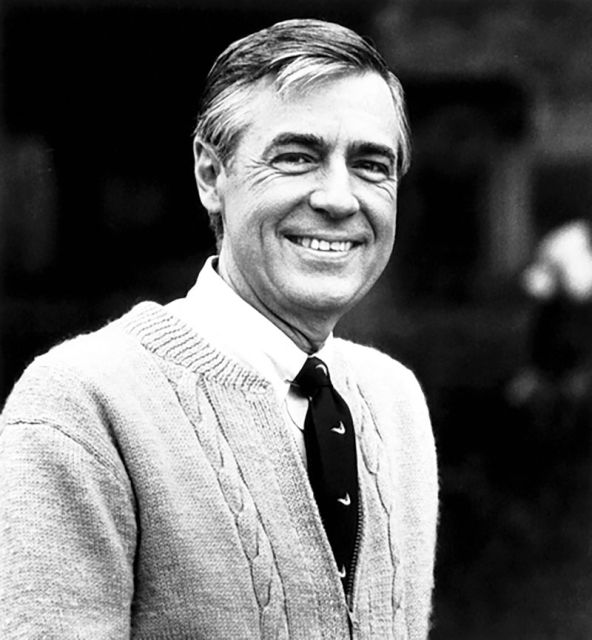
Picture Caption:
Fred Rogers signature sweaters were primarily knitted by his mother. One of those sweaters is in the collection of the Smithsonian National Museum of American History.