
A $2 Bolt vs. a $25,000 Engine… Guess Who Won
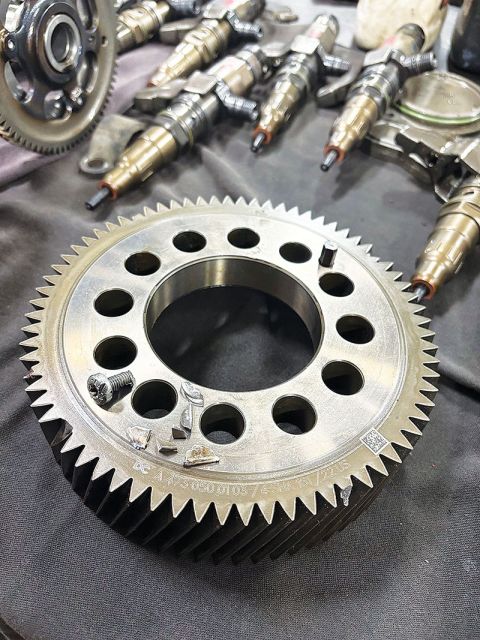
Very often, a truck comes through the door that drives home a lesson you do not forget. It is usually not some massive, obvious failure that takes things down. Often, it is something small that quietly creates a much bigger problem behind the scenes.
This one started with a 2016 Western Star 4900 equipped with a Detroit DD15. The driver came in with complaints of timing-related fault codes, poor performance, and a truck that was simply not behaving as it should on the road. At first glance, it sounded like something that could be tracked down through the usual electronic diagnostics.
Then the backstory came out.
This truck had already been to a Detroit dealer not long before. Instead of completing the repair themselves, the dealer sent the driver to an independent shop. That shop followed the recommended diagnostic steps, used the troubleshooting trees, and ultimately replaced the camshafts to correct the issue.
Despite all of that, the problem never truly went away.
Now the truck is in our shop, still acting up, still setting codes, and still not running correctly. That is when you start to wonder if the original cause was ever identified at all.
We approached it the same way we would any other job, starting with the basics. Fault codes were reviewed and documented. The factory diagnostic path was followed carefully. Wiring was inspected, connectors were checked, and the area under the valve cover was examined. Everything that could be verified without disassembly was addressed first. From there, the engine was brought to top dead center on cylinder one so the timing could be checked mechanically.
That is where things began to point in a different direction.
The cam timing was not where it should have been. It was slightly off, roughly half a tooth. That might seem minor to someone outside the industry, but in an engine like this, that amount of deviation is not normal. Components do not just shift out of place on their own without a reason.
At that point, it was clear that this was no longer a simple electrical concern. Something inside the engine had changed position, and the only way that happens is through a mechanical issue.
On a DD15, that means taking a hard look at the gear train. Because this engine uses a rear gear train configuration, access is limited while it is still installed in the chassis. These engines are designed to be removed as an assembly rather than disassembled in tight quarters, which adds another layer of complexity to the process.
Because the engine is mounted, pulling the transmission requires supporting the engine from below. The mounts are tied into the transmission, so removing it without proper support is not an option. To make that happen, the oil pan was removed so the engine could be safely supported before continuing.
That step revealed more than expected.
Resting in the bottom of the oil pan was a fuel pump bolt. It had backed out at some point, worked its way free, and dropped down into the lower end of the engine, where it would have gone completely unnoticed without taking things apart.
Finding that bolt immediately changed the picture.
Before it settled in the pan, it had already contacted moving components. It does not take long for something like that to cause damage. As it came loose, it interfered with the gear train, and in that moment, it was enough to knock teeth off the gears and shift the timing out of position. Once the damage was done, gravity did the rest, carrying it down to the bottom, where it sat, out of sight and out of mind.
At that stage, the path forward was clear. The engine needed to be removed and torn down to assess the full extent of the damage. There is no resetting or quick repair when gear teeth have been compromised.
The design of the DD15 does at least make removal more manageable in one sense. With the hood out of the way, the engine, radiator, and transmission can come out together as a single unit. It is still a significant job, but it avoids some of the challenges of separating everything inside the truck.
Once the assembly was out, disassembly began. Damaged parts were identified, replacements ordered, and the rebuilding process began. As it stands now, the engine is still being put back together, and we will follow up later on how it performs once it is back on the road.
Situations like this highlight a pattern that shows up more often than most would expect. A very small component can cause a failure requiring extensive repair. In this case, a loose fastener caused internal damage that could not be ignored.
It also reinforces the importance of how diagnostics are approached. Factory procedures and troubleshooting guides are extremely useful. They provide structure, direction, and a solid starting point for identifying issues. They are part of the process for a reason.
However, they are not a substitute for critical thinking.
Not every problem presents itself in a textbook way. There are times when the actual cause sits outside the expected path, hidden from plain view. Identifying those situations requires more than following steps. It takes experience, attention to detail, and a willingness to look beyond what is immediately obvious.
In this case, the fault codes pointed to timing; the recommended checks were performed, and major components were replaced, yet the true cause remained undetected until the engine was further disassembled.
In the end, the failure did not come from a complex system or advanced electronics. It came from a single bolt that worked its way loose and ended up in a place where it could do real damage.
That is the reality of this industry. The smallest oversight can turn into a major repair, and what seems like a simple complaint can have a much deeper cause.
When your truck is your livelihood, details matter. And sometimes, the difference between staying on the road and being stuck in a shop comes down to something no bigger than your fingernail.
Written by: Jordan Greathouse, 3600 South Noah Drive, Saxonburg, PA 16056 Website: www.Pittsburghpower.com Phone (724) 360-4080